When producing its own products, Enerpred CJSC invariably uses the process of so-called oxycarbonitration of parts. Our company has a unique technology for hardening and anti-corrosion treatment of steel and cast iron parts, which makes it possible to increase their durability by several times - liquid oxycarbonitration.
Liquid oxycarbonitration is a type of chemical-thermal treatment, which is diffusion saturation in molten salts of the surface of steel and cast iron parts with nitrogen and carbon with the formation of iron carbonitrides and nitrides, alloying elements. The thickness of the hardened layer is up to 0.2-0.3 mm. The duration of the process is from 5 to 90 minutes.
We offer organizations and enterprises a service for the oxycarbonitration of machine parts and tools, which guarantees a higher quality of products.
Oxycarbonitration provides:
increase in surface hardness by 2-5 times;
increase in wear resistance by 2-10 times;
increase in fatigue strength by 30-80%;
increase in corrosion resistance by 50-200 times;
reduction of the coefficient of friction by 1.5-2 times;
elimination of scoring and gripping in friction pairs.
As a result of such a unique combination of service properties, the durability of machine parts and the durability of the tool increase by 2-5 times. At the same time, processing costs account for 10-20% of the total cost of manufacturing parts.
Reinforced layer with respect to knitting, which excludes chipping and peeling during operation.
Liquid oxycarbonitration is also unique in that after processing, the original surface cleanliness and dimensional accuracy of the parts are preserved, which makes it possible to harden after finishing operations (grinding, polishing, honing, etc.). After oxycarbonitration, parts can be assembled without additional rework.
Thanks to oxycarbonitration, it became possible to replace such expensive and scarce materials as bronze, brass, stainless alloys with ordinary structural steel.
Steel parts processed using this technology are not inferior to bronze and brass ones in terms of corrosion resistance, coefficient of friction, ability to resist scuffing and grips, and significantly surpass them in terms of wear resistance and strength characteristics.
Almost all grades of steel and cast iron are oxycarbonated.
This technology has significant advantages over traditional processes of carburizing and nitriding in terms of saturation intensity, operational characteristics of the hardened layer, and stability of the geometry of parts.
Oxycarbonitration is most effective:
to increase the wear resistance and heat resistance of the tool (matrix, mold, die) made of heat-resistant steel in the production of aluminum profiles and die casting of aluminum alloys;
to increase the durability of machine parts operating under conditions of friction and wear (gears, shafts, bushings, sleeves, cams, threaded connections, etc.);
to increase the durability of stamping and cutting tools;
to increase corrosion resistance and facilitate assembly and disassembly after long-term operation of hardware (bolts, nuts) and other machine parts that work for a long time in corrosive environments (for example, parts of fire extinguishing systems);
for processing parts from ordinary structural steel in order to replace parts from bronze, brass, stainless steel.
By eliminating "ferrite" stains, running-in and an increase in the service life of cast iron liners of diesel engines are guaranteed.
Oxycarbonitration in a number of cases makes it possible to abandon the application of galvanic coatings on steel parts without deteriorating their operational properties, while significantly reducing the manufacturing cost.
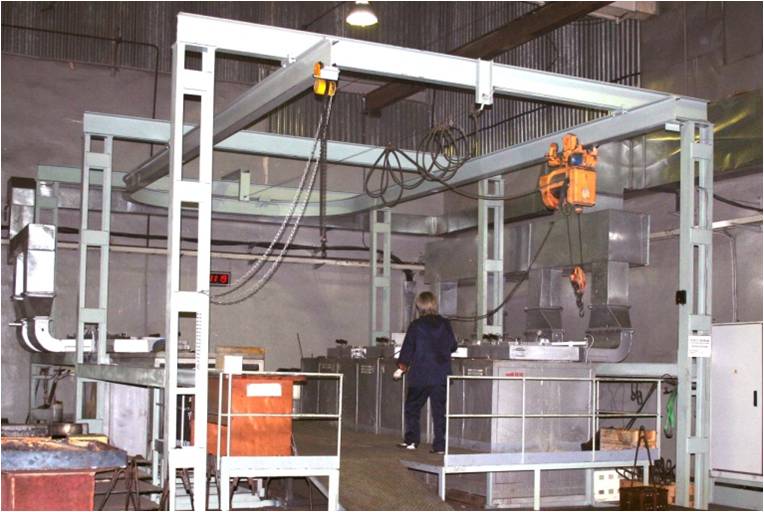
Enerpred CJSC renders services for oxycarbonitration of machine parts.